
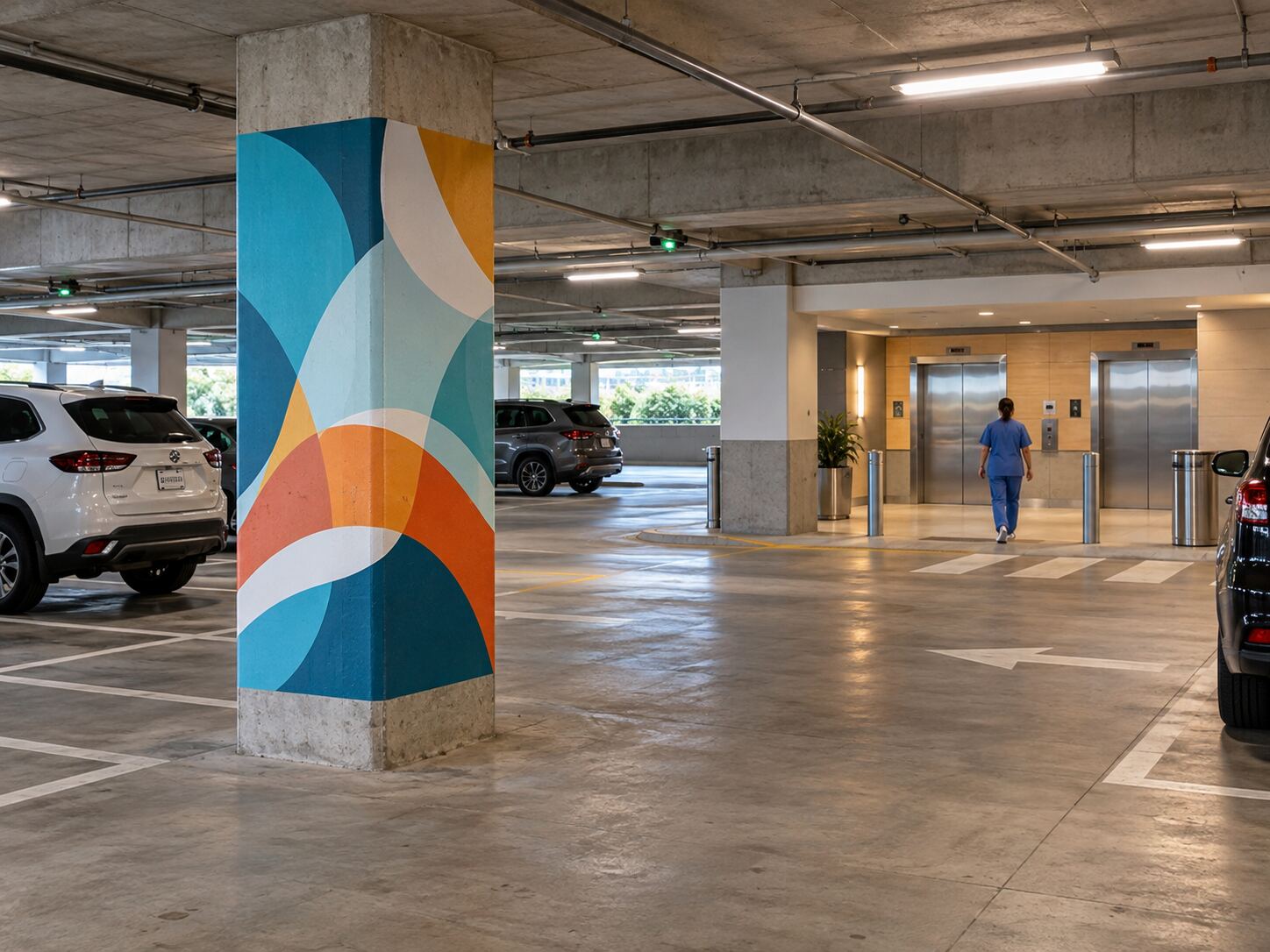
Patients, visitors and staff walk the same garage again and again. That makes it healthcare’s most overlooked media surface.
Most parking structures see strangers once. A hospital garage sees the same people repeatedly.
A patient returning for a course of infusions. A family member visiting every afternoon during a stay. A nurse who parks on the same level five days a week. That repetition is what makes column wrap advertising behave differently in a healthcare setting than almost anywhere else.
The Audience Is Large, Local and Repeat
The American Hospital Association’s Fast Facts counts 6,093 U.S. hospitals and roughly 34.4 million admissions in its 2023 survey. Admissions are only the inpatient slice. In its 2015 figures, the most recent comprehensive set AHA published for these categories, U.S. hospitals handled 142 million emergency department visits and 581 million outpatient visits. Every one of those visits is a trip that starts or ends in a parking structure.
A single hospital garage reaches three overlapping groups:
- Patients: often on a repeating schedule — dialysis, infusion, physical therapy, oncology follow-ups
- Visitors: family members who may be on site for days, usually parking in the same structure each time
- Staff: physicians, nurses and administrators who pass the same columns twice a day
For a health brand, that is a precisely defined audience in the minutes before or after a medical appointment. Dedicated hospital-garage ad networks such as Innovare Medical Media already sell the garage as its own placement category.
The Garage Is the First and Last Impression
Parking is the first physical contact a patient has with a hospital and the last. One industry survey cited in HONK’s overview of healthcare parking ranked parking as the second most important factor in a facility’s first impression, behind only the lobby. The same material reports that 97 percent of respondents had a negative impression of a parking area with rusted or run-down equipment. It also reports that patient satisfaction scores at UC Davis Medical Center rose 50 percent after a new garage opened.
Two takeaways for property owners:
- Parking is not on the HCAHPS survey directly, but a frustrating arrival colors everything after it. Condition and cleanliness of the garage matter to hospital leadership.
- A wrap program that also protects columns from vehicle contact keeps the structure looking maintained. The advertising and the upkeep reinforce each other. See the maintenance math on column protection.
What the Data Says About Healthcare Out-of-Home
An analysis from Veeva Crossix and Clear Channel Outdoor found that exposure to healthcare out-of-home campaigns was associated with higher rates of specialist visits (+20%) and prescription starts (+76%). That study measured healthcare OOH broadly, not parking garages specifically, so treat it as evidence for the channel, not a garage benchmark.
Garage placement adds three advantages the broader channel lacks:
- Frequency: repeat visitors see the same placement across many visits
- Proximity: the message is seen minutes from the care setting it refers to
- Low competition: no scrolling, no skipping, and few competing messages in the sightline
Compliance and Tone Are Part of the Product
Hospital advertising is not like retail advertising. A hospital garage program needs written rules before the first advertiser is signed:
- Prescription drug ads: FDA rules require advertisements to carry a fair statement of risk and effectiveness information. Outdoor and place-based formats are increasingly used for prescription drugs, and federal officials announced tougher direct-to-consumer drug advertising enforcement in September 2025. Pharma advertisers will have their own regulatory review, but the property owner should require proof of it.
- Patient privacy: advertising may never use patient data or imply knowledge of who is in the garage.
- Tone: avoid fear-based or anxiety-inducing creative in a setting where visitors are already stressed.
- Category list: decide in advance which categories are allowed, restricted or off-limits, and who approves exceptions.
This is a framework, not legal advice. Hospital compliance and legal teams should set the final policy.
How to Evaluate a Hospital Garage for Advertising
Before approaching advertisers, document the numbers they will ask for:
- Weekly vehicle entries, split by patient, visitor and staff where the data exists
- Share of repeat visitors, such as scheduled outpatient programs
- Peak hours and average time in the structure
- The paths with the most foot traffic: elevator banks, pay stations and entrances to the emergency and outpatient departments
Here is how the math works, using illustrative numbers rather than Cingo data. A garage logging 4,000 vehicle entries per week, with a driver passing a given column four times per visit, produces roughly 16,000 exposures per week on that column alone. Repeat visitors push the frequency per person higher still. Advertisers buy on exactly those two numbers, reach and frequency, so a documented count is worth more than any pitch deck.
Installation Without Disrupting Care
A hospital garage cannot close. Column wraps install around existing structural columns without demolition, so work can be phased level by level, scheduled around peak visiting hours and kept out of emergency access lanes. Verify local signage permits and fire-safety requirements before installation, since both vary by municipality.
Frequently Asked Questions
Can pharmaceutical brands advertise in a hospital parking garage?
In principle, yes. Prescription drug advertising must meet FDA requirements for a fair statement of risk and effectiveness information, and each hospital sets its own category policy. A property owner should require the advertiser’s regulatory approval and write down which categories are allowed, restricted or off-limits.
Who sees advertising in a hospital garage?
Three overlapping groups: patients, who often return on a repeating schedule; visitors, who may be on site for days; and staff, who pass the same columns twice a day. The American Hospital Association counted about 34.4 million admissions in its 2023 survey, plus 142 million emergency visits and 581 million outpatient visits in its 2015 figures.
Does garage advertising affect how patients see the hospital?
It can. Parking is the first and last physical contact a patient has with a hospital, so condition and tone matter. Calm, well-designed creative and a maintained structure help. Fear-based creative does not belong in a setting where visitors are already stressed.
How is a column wrap installed in an operating hospital garage?
Wraps install around existing structural columns without demolition, so work can be phased level by level, scheduled outside peak visiting hours and kept clear of emergency access lanes. Local signage permits and fire-safety requirements should be verified before installation.
The Bottom Line
A hospital garage already carries a captive, repeat audience that health brands pay to reach elsewhere. It is also the first and last thing patients experience. Done well, a wrap program protects the structure, improves how it looks, and turns unused concrete into ancillary income.
Done carelessly, it creates compliance and reputation risk. The difference is policy, documentation and creative standards set up front.
For a view of how formats compare, see column wraps vs. wall banners vs. digital displays. For other garage types, see university and airport garages.
—
Cingo [Column Wraps] protects parking infrastructure through proprietary materials designed for parking environments. Reduce maintenance costs, preserve aesthetics, and unlock revenue opportunities. Get in touch.