
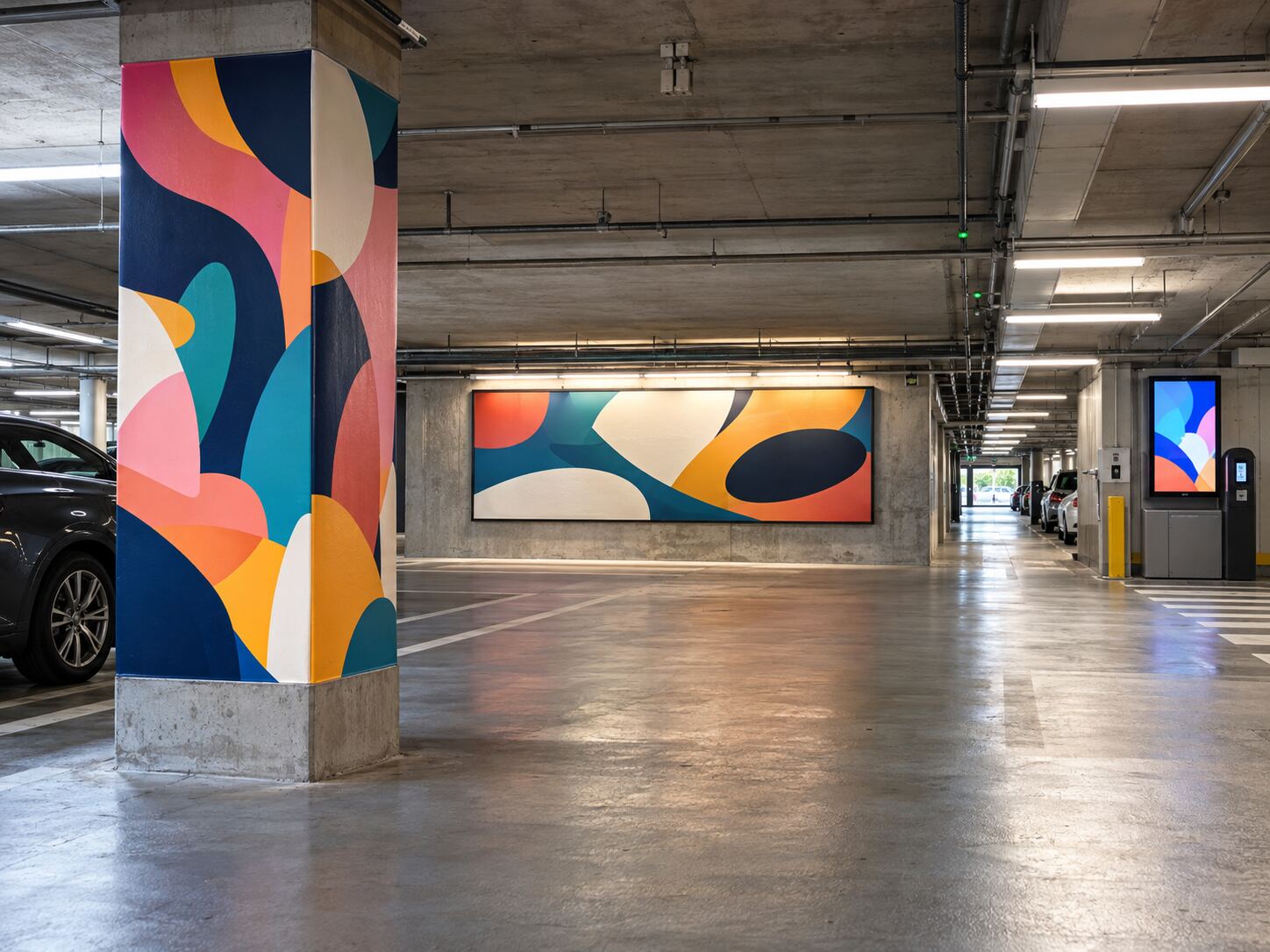
Five formats, five jobs. The right program matches each one to a location, a goal and a budget.
A parking garage does not have to pick one advertising format. Column wraps, wall banners, elevator and stairwell ads, floor decals and digital screens can all work inside the same structure. The mistake is treating them as interchangeable. Each one earns its place in a different spot, for a different advertiser goal, at a different cost.
The Five Formats at a Glance
| Format | Best for | Where it sits | Changing creative |
|---|---|---|---|
| Column wrap | Awareness through repetition | Drive aisles, entries, exits, near elevators | Reprint and reinstall |
| Wall banner or mural | Launches and announcements | End walls and long sightlines | Reprint and reinstall |
| Elevator and stairwell ad | Maximum uninterrupted attention | Elevator lobbies, stairwells | Reprint and reinstall |
| Floor decal | Wayfinding with sponsorship | Walkways, crosswalks, pay areas | Replace decal |
| Digital screen | Time-sensitive and rotating offers | Pay stations, entrances | Minutes, no print |
Static vs. Digital: The Real Cost Gap
The biggest decision is not which static format to use. It is static versus digital.
Digital screens cost more to install and operate. Industry cost breakdowns for digital out-of-home, such as ScreenCloud’s digital billboard guide, put installation anywhere from about $10,000 to $50,000 or more depending on site complexity, with dedicated power, connectivity and content-management software. Those figures cover larger outdoor installations, and a small indoor screen near a pay station costs less, but the structure of the cost is the same: hardware, power, network, software and a technician when something fails.
Static formats avoid nearly all of that. There is no software subscription, no screen replacement cycle and no blank screen from a dropped connection. Maintenance is checking for peeling or damage. The trade-off appears when creative changes. Industry sources such as SEEN Labs put a static creative change at roughly $300 to $2,000 in printing and installation, with a lead time of several days.
The math works like this, using the ranges above as illustrative inputs. An advertiser that changes creative four times a year on one static placement spends roughly $1,200 to $8,000 a year on reprints. A digital screen has no reprint cost, but it carries the upfront and ongoing expense above. Digital wins where creative changes often or several advertisers share one screen. Static wins where a placement runs for months and cost control matters.
Match the Format to the Location
- Entry and exit lanes: column wraps. Drivers pass the same columns on the way in and out, producing repeat exposure on every visit.
- Elevator lobbies and stairwells: the longest uninterrupted pause in the garage. Attention is high even though total reach is lower than at the entrance.
- Pay stations and kiosks: visitors are stationary and looking for information, which suits a digital screen with a timed message.
- Long walkways and end walls: wall banners and floor decals, which read from a distance across a full level.
Match the Format to the Advertiser’s Goal
- Build awareness over months: column wraps. They offer the lowest cost per impression over a long placement.
- Announce a launch or event: wall banners and murals, which work best for a defined campaign window.
- Promote time-sensitive offers: digital screens, where creative changes in minutes.
- Earn visitor goodwill: floor decals that give directions and carry sponsorship together.
- Reach a captive audience with no distraction: elevator and stairwell placements.
Sizing a Program to the Garage
The flagship guide describes a typical pattern. A smaller garage might run three column wraps and a wall banner. A large airport structure might deploy a full network of digital displays with rotating inventory. A practical order of operations:
- Start with column wraps at the highest-traffic columns near elevators and pay stations. They are the lowest-complexity format and also protect the columns.
- Add a wall banner where a long sightline exists and an advertiser has a defined campaign.
- Add digital only once traffic data shows enough rotating demand to justify the infrastructure.
Digital out-of-home is projected to reach more than 40% of total OOH spend by 2029, so the infrastructure decision is one to plan for even if it is not step one.
Check the Rules First
Whatever the format, installations must not block exit signs, fire safety notices or driver sightlines. Use fire-resistant materials and verify local signage permits, since requirements vary by municipality.
Frequently Asked Questions
What is the cheapest parking garage ad format to start with?
Static formats, meaning column wraps, wall banners and floor decals. They cost less to install than digital screens and need no software, power infrastructure or connectivity, which is why most programs start there.
How long does it take to change a static ad versus a digital one?
A static creative change needs new printing and reinstallation, commonly several days at roughly $300 to $2,000 according to industry sources. A digital screen can change creative in minutes with no print cost.
Can one garage run several ad formats at once?
Yes. A typical program uses a mix, for example three column wraps and a wall banner in a smaller garage, or a network of digital displays in a large airport structure. Most programs add formats in stages as traffic data and advertiser demand justify them.
Which format works best in a hospital, university or airport garage?
Format follows visitor behavior more than property type. Repeat-visit environments such as hospitals and campuses suit column wraps and elevator placements. Airports with long dwell near pay stations can support digital screens. See the hospital, university and airport guides for detail.
The Bottom Line
There is no best format, only the best format for a location and a goal. Static formats are the lower-cost, lower-maintenance foundation. Digital adds flexibility at a higher fixed cost. Most garages end up with a mix, built in stages as traffic data and advertiser demand justify it.
See how the mix changes by property type: hospital, university and airport garages. For the full picture, read the column wrap advertising guide.
—
Cingo [Column Wraps] protects parking infrastructure through proprietary materials designed for parking environments. Reduce maintenance costs, preserve aesthetics, and unlock revenue opportunities. Get in touch.