
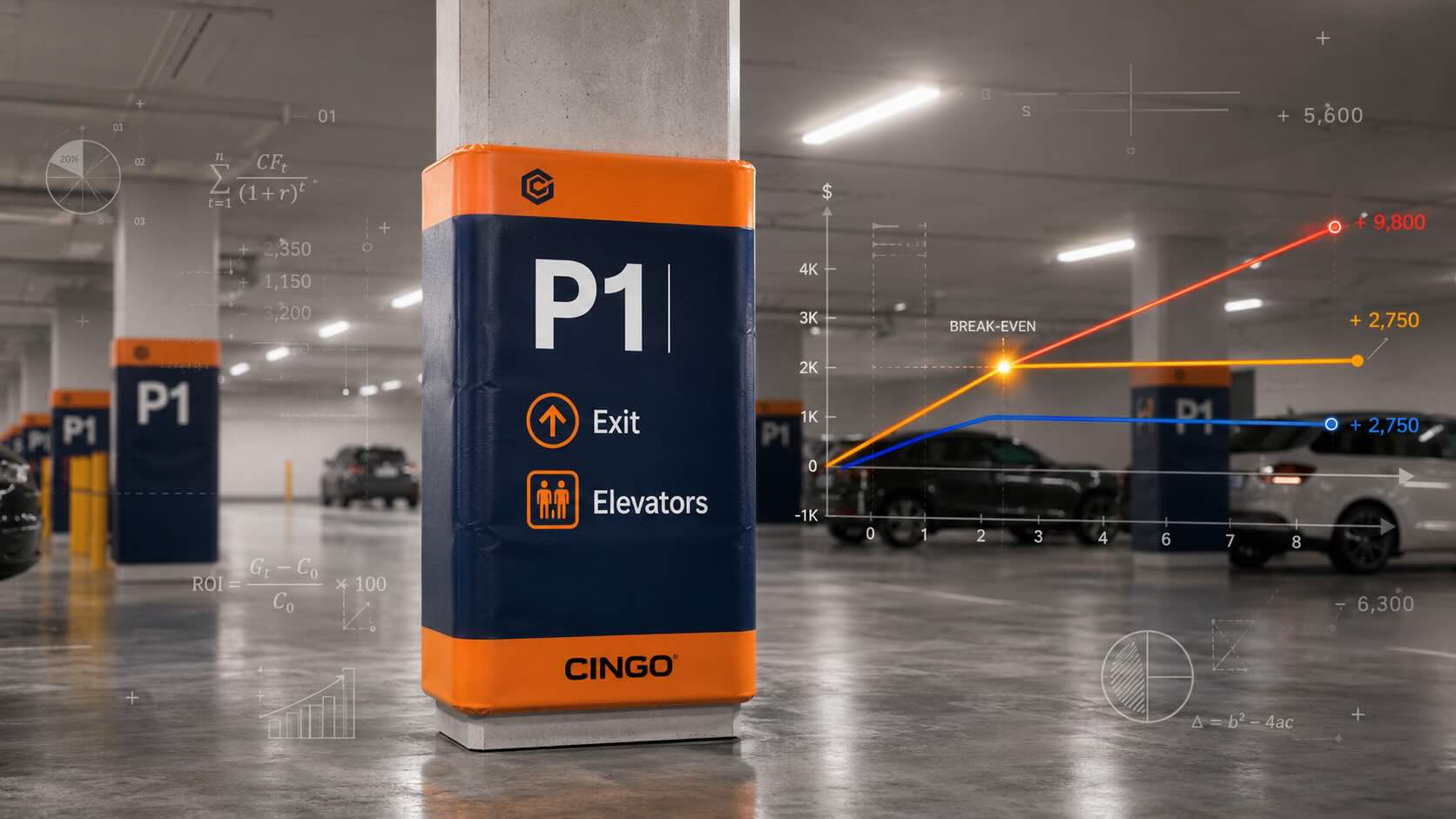
The ROI case for column wraps-before you even factor in advertising revenue.
Let’s talk maintenance math.
If you manage parking structures, you know the cycle: vehicles brush against columns, leaving tire marks and paint transfer. Mirrors clip corners, chipping concrete. Over time, columns accumulate visible damage that makes the garage look neglected.
The standard response is reactive maintenance — patching concrete, repainting surfaces, addressing damage as it becomes unsightly enough to warrant action. It’s an ongoing operational expense that never really ends.
But there’s a different approach. One that pays for itself through avoided maintenance costs — before you even factor in the advertising and branding opportunities.
The True Cost of Column Damage
Individual repairs seem manageable:
- Minor concrete patching: $200-500 per incident
- Significant chip or spall repair: $500-1,500
- Column repainting: $300-800 depending on size
- Structural repair for repeated damage: $1,000-3,000+
But the cumulative cost is substantial. A parking structure with 100+ columns will see dozens of damage incidents annually. Each repair requires coordination — identifying the damage, scheduling contractors, managing the work around operating hours.
More critically, maintenance is always reactive. By the time damage is repaired, it’s been visible for weeks or months. The garage perpetually exists in a state of visible wear, with fresh damage accumulating faster than repairs can address it.
The Hidden Costs
Beyond direct repair expenses, column damage creates secondary costs:
- Aesthetic degradation: A beat-up garage signals deferred maintenance throughout the property, affecting perception of the entire asset
- Guest/tenant complaints: Visible damage generates complaints that consume management time even when no action is taken
- Vehicle damage claims: When vehicles contact rough, damaged concrete, they sustain more damage than they would against smooth surfaces — increasing liability exposure
- Capital depreciation: Accumulated damage accelerates the timeline for major renovation or structural work
These costs don’t show up in maintenance line items, but they’re real. A garage that looks neglected affects property perception, tenant satisfaction, and ultimately asset value.
The Protection Alternative
Column wraps designed for parking environments offer a different model: prevention rather than repair.
The principle is straightforward. Proprietary materials engineered to absorb impact protect the underlying concrete. Minor vehicle contact — the kind that happens constantly in parking environments — is absorbed by the wrap rather than damaging the structure.
When significant impact occurs, the wrap can be replaced or repaired at a fraction of the cost of concrete work. The underlying column remains protected.
The ROI Calculation
Consider a representative scenario:
A parking structure with 150 columns experiences 40 damage incidents annually requiring repair. At an average cost of $400 per repair (including labor, materials, and coordination), that’s $16,000 in annual maintenance — recurring indefinitely.
Column wraps for the same structure might represent a one-time investment of $30,000-50,000 depending on specifications. At year three, the cumulative maintenance savings have offset the initial investment. Every subsequent year is net positive.
More importantly, the garage maintains its appearance consistently rather than cycling between damage and repair. The aesthetic benefit is immediate and sustained.
The Replaceable Component
Unlike concrete, column wraps are designed as replaceable components.
Graphics fade or become dated? Replace them. Significant impact damages a section? Replace that section. Branding changes? Update the graphics without touching the underlying structure.
This converts a fixed asset (concrete columns that can only deteriorate) into a maintainable system that can be refreshed, updated, and repaired at the component level.
The Revenue Upside
The maintenance ROI calculation assumes no advertising or branding value — purely cost avoidance. But column wraps enable revenue opportunities that plain concrete cannot:
- Tenant sponsorships and third-party advertising
- Branded wayfinding that improves visitor experience
- Seasonal promotions and event-specific graphics
- Premium EV charging zone branding
The protection pays for itself. The advertising is upside.
The Ownership/Investor Conversation
When presenting the case to ownership or investors, frame it in their terms:
- Capex vs. Opex: One-time capital investment replaces ongoing operational expense
- Asset preservation: Protection extends the useful life of parking infrastructure
- NOI improvement: Reduced maintenance expense and potential advertising revenue both improve net operating income
- Aesthetic consistency: Property maintains premium appearance rather than cycling through damage states
The maintenance math alone justifies the investment. Everything else is additional value.
The Bottom Line
Column damage is treated as inevitable. It doesn’t have to be.
Protective wraps convert recurring maintenance expense into a one-time investment. They maintain aesthetic consistency instead of perpetual damage-and-repair cycles. They’re replaceable at the component level rather than requiring structural work.
Protection pays for itself. Advertising is upside. The only question is how long you want to keep paying for the same concrete repairs.
—
Cingo [Column Wraps] protects parking infrastructure through proprietary materials designed for parking environments. Reduce maintenance costs, preserve aesthetics, and unlock revenue opportunities.