
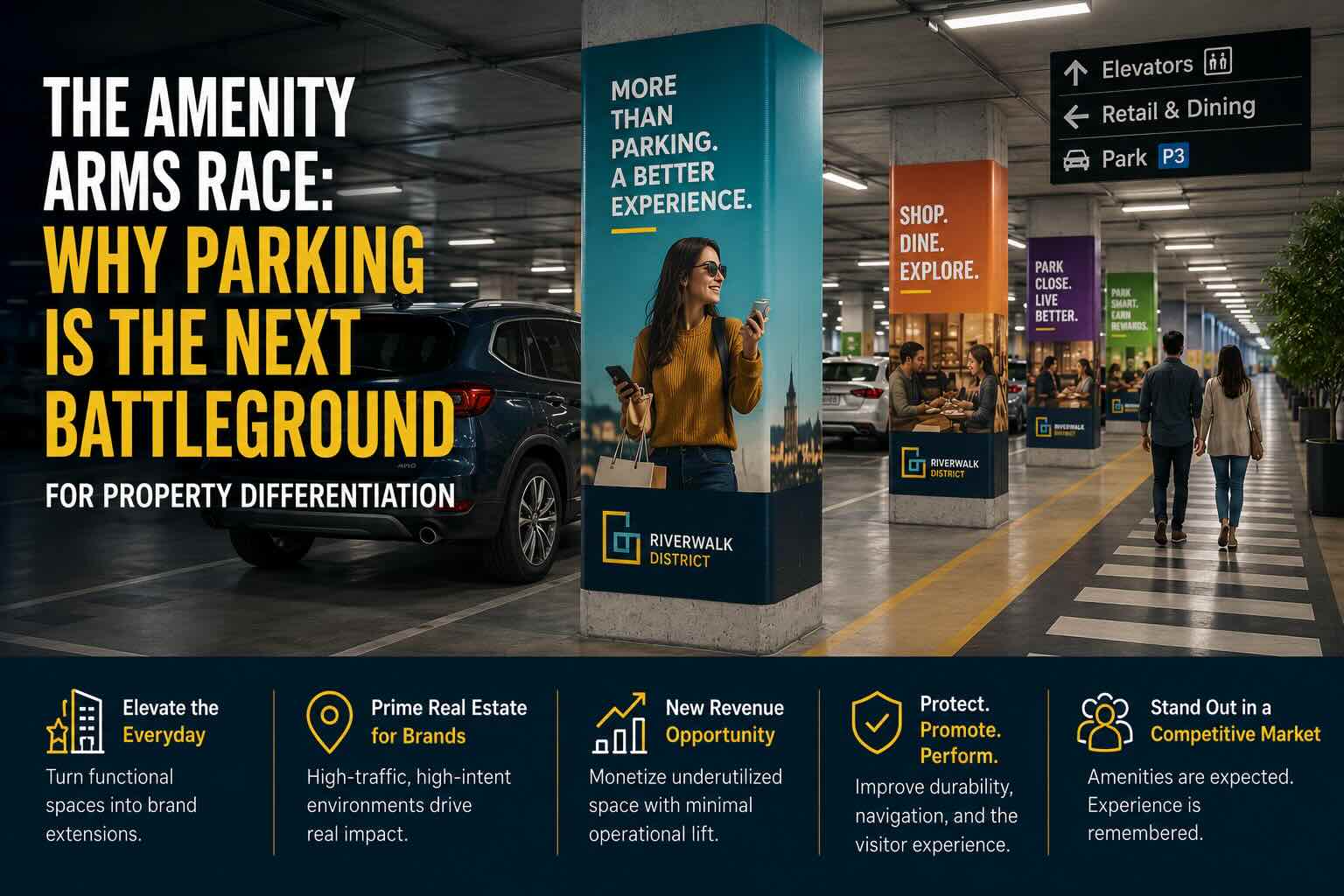
Developers have exhausted the obvious amenities. The parking structure is the untapped frontier.
Rooftop pools. Coworking lounges. Pet spas. EV charging stations. Package lockers. Bike storage with repair stands.
If you’re developing, managing, or investing in commercial or multifamily real estate, you’ve watched the amenity arms race intensify over the past decade. Every competitive property now offers some version of the same playbook — and differentiation has become nearly impossible.
So what’s left?
The parking structure.
It sounds counterintuitive. Parking garages are utilitarian. Functional. The last place most developers think about when crafting a brand experience. But that’s precisely why they represent such an outsized opportunity.
The First and Last Impression You’re Ignoring
Consider the guest journey at a luxury hotel. They’ve browsed beautiful photography online, read glowing reviews, and arrived with high expectations. Then they pull into a dim, scuffed, confusing parking garage with faded paint and exposed concrete damage.
That’s the actual first impression, not the lobby.
The same applies to multifamily. A prospective resident tours your amenity-rich property, loves the unit, and then walks back through a garage that looks like an afterthought. That cognitive dissonance matters. It signals where you cut corners.
Research backs this up. PwC found that 73% of consumers say experience is a key factor in their purchasing decisions and brand loyalty. A scuffed, confusing garage is part of that experience whether you designed it to be or not.
The Data on Arrival Experience
A 2025 study published in ScienceDirect found that environmental information positively affects both customer satisfaction (β = 0.572) and customer experience (β = 0.339), with wayfinding serving as a significant mediating factor. Translation: how easily people navigate your space directly impacts how they feel about your property.
Separate research indicates that effective wayfinding can lead to a 15% increase in customer satisfaction. For hotels, that translates to reviews, repeat bookings, and willingness to pay premium rates. For multifamily, it means lease renewals and referrals.
The average person spends 10% of their time in a complex environment feeling lost. In a parking garage, that percentage is likely higher — multiple levels, identical columns, unclear elevator access, forgotten parking spots. Every moment of confusion erodes the premium experience you’ve invested millions to create elsewhere in the building.
What Forward-Thinking Properties Are Doing Differently
The solution isn’t complicated, but it requires rethinking the garage as a brand touchpoint rather than a utility space.
Leading developers and hotel operators are now treating parking structures with the same attention they give lobbies:
- Visual consistency: Branded column treatments that extend the property’s design language into the garage
- Intuitive wayfinding: Color-coded zones, clear level identification, and visual landmarks that reduce cognitive load
- Physical protection: Column wraps that prevent the inevitable scuffs, tire marks, and paint transfer that make garages look neglected within months of opening
- Flexibility: Graphics that can be updated seasonally or for special events, keeping the space fresh
The Competitive Advantage
Here’s the opportunity: because most properties ignore the parking experience, the bar is remarkably low. A clean, branded, easy-to-navigate garage stands out precisely because it’s rare.
For developers, this translates to faster lease-up and stronger first impressions during tours. For hotels, it means reviews that don’t mention “confusing parking” or “beat-up garage.” For multifamily, it’s a talking point that signals attention to detail throughout the property.
The Woodruff Arts Center in Atlanta recently transformed their parking structure from a forgettable utility space into an extension of their arts-focused brand. The result wasn’t just aesthetic improvement, it changed how visitors perceived the entire campus.
The Bottom Line
The amenity arms race has reached diminishing returns. Every competitive property offers the same rooftop deck, the same fitness center, the same coworking space. Differentiation now requires looking where others aren’t and the parking structure is hiding in plain sight.
Your garage is the first thing visitors experience and the last thing they see before leaving. It’s either reinforcing your brand promise or undermining it. There’s no neutral.
—
Cingo [Column Wraps] transforms parking infrastructure into branded, functional assets protecting vehicles, guiding guests, and extending your property’s design language from arrival to departure. Learn more at cingos.com.
Frequently Asked Questions About Parking as an Amenity and Differentiator
01Why is the parking structure the next amenity for differentiation?
+
The article says developers have exhausted the obvious amenities, such as rooftop pools, coworking lounges, pet spas, EV charging, package lockers and bike storage, so every competitive property offers a version of the same playbook and differentiation has become nearly impossible. Parking is the untapped frontier because it is utilitarian and rarely considered part of the brand experience, which is why it represents an outsized opportunity. It is also the first and last thing visitors experience.
02How does wayfinding in a garage affect customer satisfaction?
+
The article cites a ScienceDirect study finding that environmental information positively affects customer satisfaction and customer experience, with wayfinding as a significant mediating factor, and separate research suggesting effective wayfinding can lift customer satisfaction by 15 percent. For hotels, the article links this to reviews, repeat bookings and willingness to pay premium rates; for multifamily, to lease renewals and referrals. Verify the original studies before quoting the 15 percent figure.
03How much time do people feel lost in complex spaces like garages?
+
The article says the average person spends 10 percent of their time in a complex environment feeling lost, and that a garage is likely higher because of multiple levels, identical columns, unclear elevator access and forgotten parking spots. Every moment of confusion, it argues, erodes the premium experience a property has invested millions to create elsewhere. The 10 percent figure is quoted from separate research the article does not name.
04What are forward-thinking properties doing with their garages?
+
The article lists four things. Visual consistency: branded column treatments that extend the property’s design language into the garage. Intuitive wayfinding: color-coded zones, clear level identification and visual landmarks. Physical protection: column wraps that prevent the scuffs, tire marks and paint transfer that make garages look neglected within months of opening. Flexibility: graphics that can be updated seasonally or for special events, keeping the space fresh.
05What competitive advantage does a branded garage give developers, hotels and multifamily properties?
+
Because most properties ignore the parking experience, the article says the bar is remarkably low and a clean, branded, easy-to-navigate garage stands out because it is rare. For developers it means faster lease-up and stronger first impressions on tours. For hotels it means reviews that do not mention confusing parking or a beat-up garage. For multifamily it is a talking point that signals attention to detail. The article points to the Woodruff Arts Center in Atlanta as an example of a garage turned into an extension of its arts brand.