
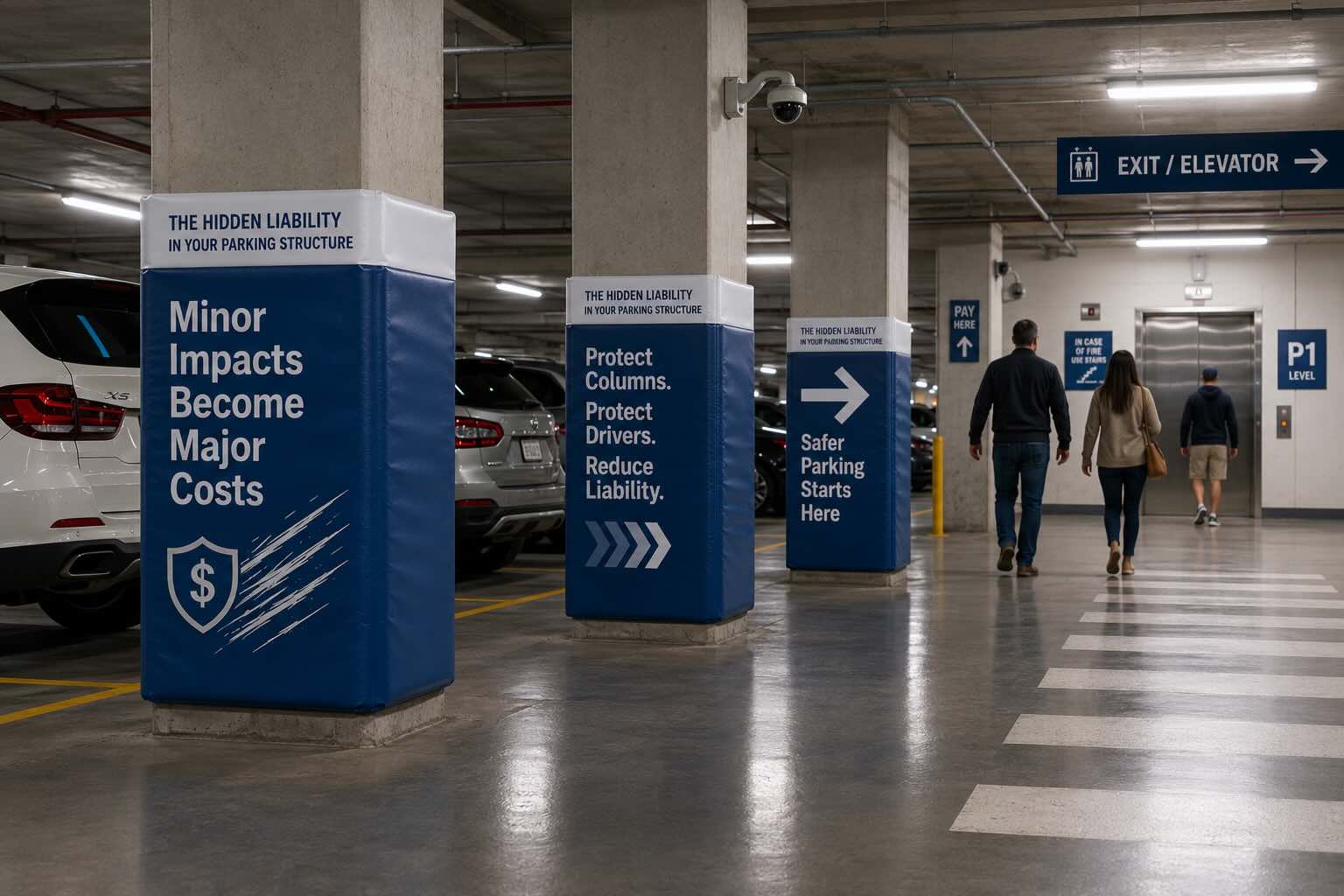
Column damage is a slow bleed of money, reputation, and maintenance hours. There’s a better way.
Here’s a scenario every property manager recognizes:
A guest pulls into your parking garage, misjudges the turn, and scrapes their car against a concrete column. They file a damage claim. Leave a 1-star review mentioning “the parking garage.” Maybe they escalate to their insurance company, which contacts yours.
It’s not catastrophic. But multiply it across dozens of incidents per year, and you’re looking at a slow bleed claims processing, maintenance repairs, reputation damage, and the ongoing cost of concrete that looks progressively worse.
European properties figured this out two decades ago. The solution is finally available in the U.S.
The True Cost of Column Damage
Concrete column repairs aren’t cheap. Depending on severity, a single repair runs $500 to $2,000 or more. But the visible damage accumulates faster than most properties can address it:
- Tire marks and rubber transfer from vehicles brushing against columns
- Paint transfer from side mirrors and doors
- Chips and spalling from repeated minor impacts
- Rust staining from exposed rebar in older structures
Most properties operate in “patch and paint” mode, addressing damage reactively, watching columns deteriorate between maintenance cycles, and accepting that garages simply look worse over time.
The aesthetic impact matters more than many operators realize. A beat-up garage signals deferred maintenance throughout the property. For hotels, it undercuts the premium experience guests are paying for. For multifamily, it raises questions about how the building is managed overall.
The Liability Angle
Beyond aesthetics, there’s the insurance and liability exposure.
Garagekeepers insurance which covers damage to vehicles in your care, typically ranges from $50,000 to $1,000,000 or more in coverage, depending on the value of vehicles you handle and your risk profile. Every claim affects your premiums and loss history.
Vehicle owners who damage their cars in your garage may file claims against your property, especially if they can argue that column placement, lighting, or lack of protection contributed to the incident. Even if claims are denied, the administrative burden and reputation impact add up.
Valet operations face particularly acute exposure. When your staff is parking high-value vehicles in tight spaces, the margin for error shrinks. A single incident with a luxury vehicle can result in claims exceeding $10,000.
The European Solution
European parking operators confronted this problem years ago, driven by tighter spaces, higher vehicle density, and different liability frameworks. The solution that emerged: protective column wraps designed specifically for parking environments.
Unlike rubber bumpers or foam padding which look industrial and deteriorate quickly. These systems use proprietary materials engineered to absorb impact while maintaining a clean, professional appearance. Graphics can be applied for branding and wayfinding, transforming a protective measure into a visual asset.
The concept, developed in the Netherlands in 2003, has been installed in hundreds of European projects across a dozen markets. Properties ranging from retail centers to hospitals to airports have adopted the approach, not as an afterthought, but as a standard specification.
The ROI Calculation
The math isn’t complicated:
- Reduced repair costs: Column wraps absorb the minor impacts that would otherwise damage concrete. The wrap material is replaceable; the underlying structure stays protected.
- Lower claims exposure: Visible protection demonstrates proactive risk management. Vehicles that brush against padded columns sustain less damage than those hitting raw concrete.
- Preserved aesthetics: Columns maintain their appearance over time instead of accumulating visible damage between maintenance cycles.
- Potential insurance benefits: Demonstrable safety improvements can support conversations with insurers about risk profiles and premiums.
Before factoring in any advertising or branding value, column protection often pays for itself through avoided maintenance and claims. The revenue generation opportunity is upside.
Why This Matters Now
Vehicle sizes have increased significantly over the past two decades. SUVs and trucks now dominate the market, making garages designed for smaller vehicles feel increasingly tight. The result: more frequent column contact, more damage to vehicles and infrastructure, more claims and complaints.
Simultaneously, customer expectations have risen. A scuffed, damaged garage was acceptable when parking structures were purely utilitarian. Today, when the parking experience is the first and last touchpoint with your property, visible neglect carries a cost.
The Bottom Line
Column damage is a problem every parking operator accepts as inevitable. It doesn’t have to be.
European properties solved this years ago with protective systems that pay for themselves through avoided maintenance, reduced liability exposure, and preserved aesthetics. The solution is now available in the U.S., manufactured domestically with materials and processes proven across hundreds of international installations.
Cingo [Column Wraps] protects parking infrastructure and vehicles through proprietary materials designed specifically for parking environments. Made in the USA with technology proven across Europe. Learn more at cingos.com.