
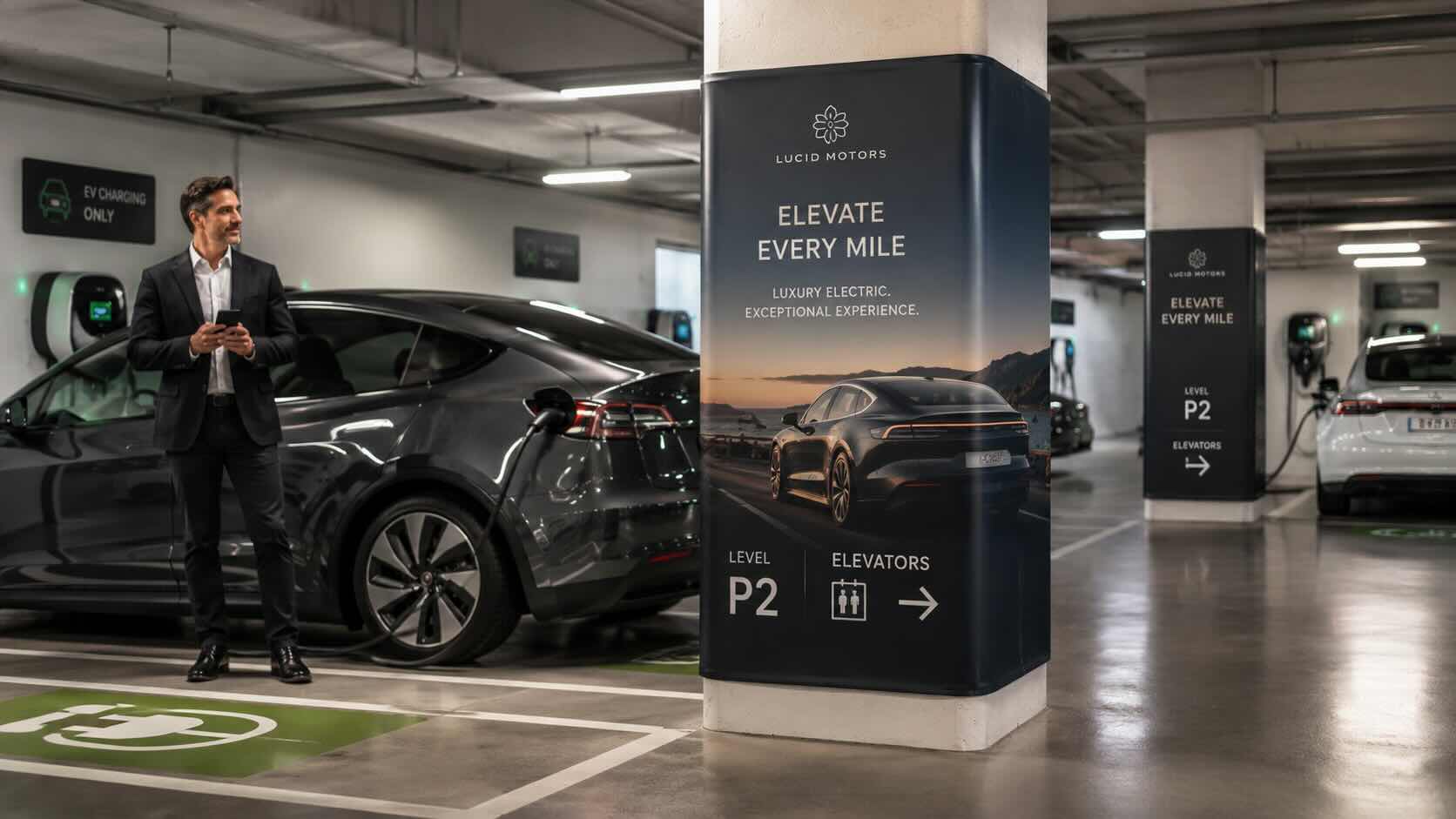
Everyone’s focused on charger installation. Smart operators are thinking about what happens during the 30-60 minute session.
EV infrastructure isn’t optional anymore.
Whether it’s tenant demand, local building codes, competitive pressure, or sustainability commitments, electric vehicle charging is coming to your property. The question isn’t if, it’s how you’ll implement it.
Most operators are focused on the hardware: charger selection, electrical capacity, installation logistics, pricing structures. Important considerations, certainly. But they’re missing a significant opportunity hiding in plain sight.
EV charging takes time. And that time represents a captive, affluent audience with nothing to look at.
The Charging Time Reality
Unlike filling a gas tank (a 5-10 minute transaction) EV charging takes significantly longer.
Level 2 chargers, the most common type at commercial properties, require 30 minutes to several hours depending on vehicle and battery state. Even DC fast chargers need 20-45 minutes for a meaningful charge.
That’s a fundamentally different customer behavior pattern. Gas station customers are transactional, in and out quickly. EV drivers are captive and waiting in or near their vehicles for extended periods.
Smart operators recognize this creates two distinct opportunities: keeping drivers on-property spending money, and monetizing their attention during the wait.
The EV Driver Demographic
EV owners represent a premium demographic that advertisers covet:
- Income: Over 70% of EV owners earn $75,000 or more annually
- Education: 70% are college educated
- Age: 65% are over 40, peak earning and spending years
- Mindset: Early adopters willing to pay premium for innovation and sustainability
This is precisely the audience brands want to reach. High income, high education, demonstrated willingness to invest in premium products. And they’re waiting in your parking structure with time to absorb messaging.
The Infrastructure Investment Wave
The scale of EV charging infrastructure investment is substantial. The U.S. EV charging infrastructure market was valued at $5.09 billion in 2024 and is projected to grow at a CAGR of 30.3% through 2030, according to Grand View Research.
California alone announced $1.4 billion in charging station investments in early 2025. Federal programs, state incentives, and utility rebates are making installation increasingly accessible for property owners.
But while billions flow into hardware, relatively little attention goes to optimizing the charging experience itself, including how the space around chargers is designed and monetized.
Dual Revenue Streams
Forward-thinking operators are recognizing that EV charging zones offer two distinct revenue opportunities:
Revenue Stream 1: Charging Fees
The obvious model — charging per kWh or per minute of charging time. This offsets infrastructure costs and can generate modest ongoing revenue. Some operators offer free charging as an amenity; others monetize directly.
Revenue Stream 2: Advertising and Branding
The less obvious model — monetizing the attention of captive, affluent drivers during their extended wait times. Column wraps near charging stations become premium ad real estate, visible to drivers who are stationary, not rushed, and actively looking around.
Some charging networks already generate revenue through advertising displayed on charging equipment. The same principle applies to the surrounding environment, columns, walls, and wayfinding elements that drivers see throughout their charging session.
Property-Specific Applications
Different property types can leverage EV charging zones differently:
- Hotels: Promote on-property restaurants, spa services, and amenities. Guests charging overnight are ideal targets for upselling experiences they might not otherwise discover.
- Retail: Guide charging drivers to specific stores or dining options. The 30-60 minute wait time aligns perfectly with shopping or restaurant visits.
- Multifamily: Reinforce property branding and highlight resident amenities. EV charging areas become another touchpoint for community building.
- Office: Feature tenant businesses, building amenities, or third-party advertisers targeting the professional demographic.
The Design Opportunity
EV charging zones tend to be placed strategically, often near entrances, elevators, or in dedicated sections of the garage. This positioning makes them high-visibility areas.
Rather than treating these zones as purely functional, consider them as designed spaces:
- Branded column wraps that reinforce property identity
- Wayfinding that guides drivers to elevators, amenities, or exits
- Advertising placements for premium sponsors targeting the EV demographic
- Protected columns that prevent vehicle damage during tight-space maneuvering
The infrastructure investment is happening regardless. The question is whether you’ll maximize the return by thoughtfully designing the experience around it.
The Bottom Line
EV-ready isn’t enough. EV-optimized means thinking beyond the charger itself.
The 30-60 minutes drivers spend waiting represents attention you can monetize, either through on-property spending or through advertising revenue. The affluent, educated EV demographic is exactly the audience premium brands want to reach.
Charger installation is table stakes. Monetizing the wait time is the opportunity.
Cingo [Column Wraps] transforms EV charging zones into branded, protected, revenue-generating spaces. Capture the attention of captive, affluent audiences while protecting your infrastructure investment.