
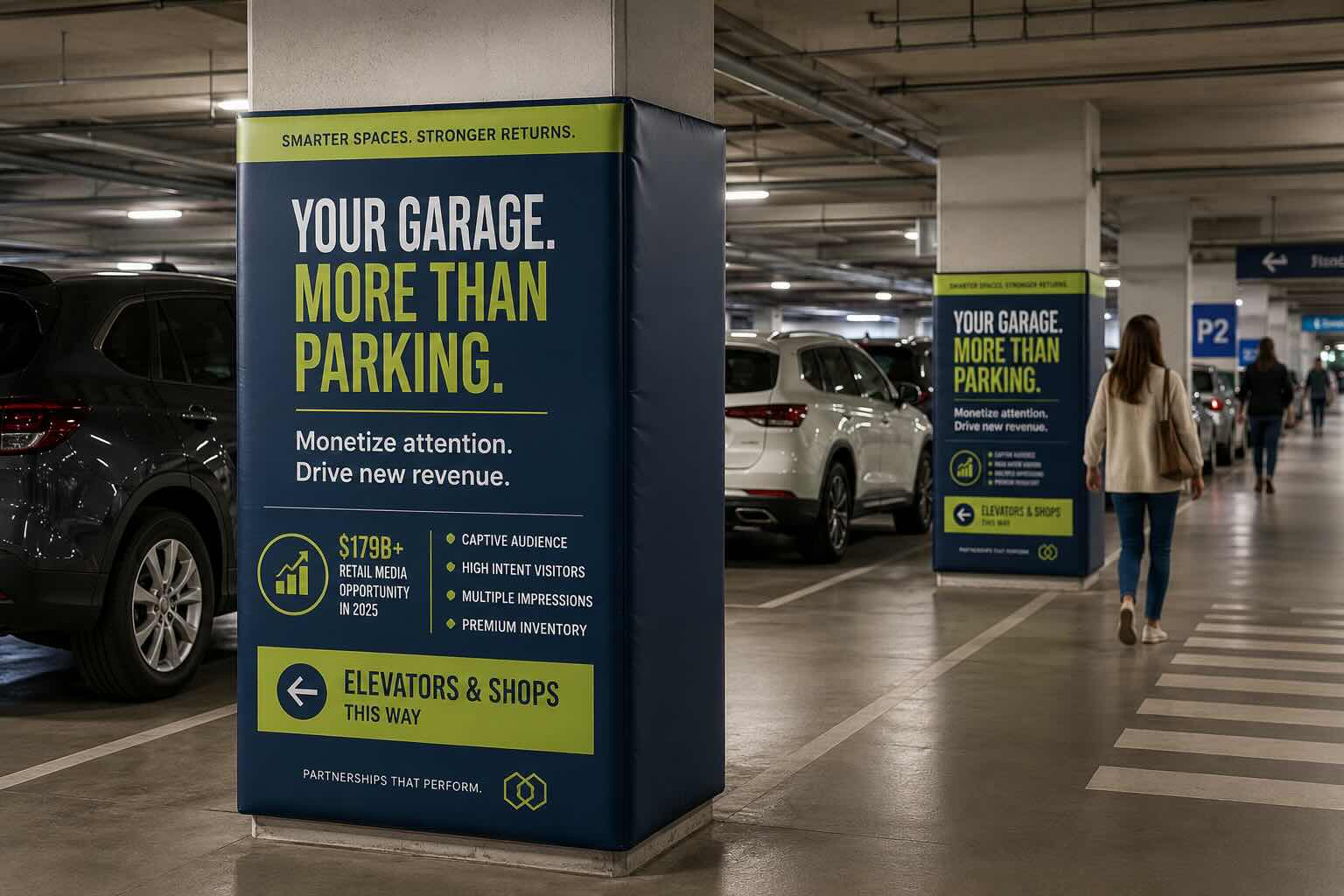
Hourly parking is a commodity. Attention is the new asset class.
Everyone charges roughly the same for parking.
Whether you’re operating a hospital garage, a retail parking deck, or a downtown structure, the pricing model is nearly identical: hourly rates, daily maximums, maybe monthly passes. It’s a commodity business where differentiation happens at the margins.
So how do the smartest operators pull ahead?
They’re monetizing attention, not just space.
The $179 Billion Opportunity
Retail media networks, the advertising platforms built into retail environments are projected to generate $179.5 billion globally in 2025, according to industry analysts. That figure is now surpassing total TV advertising revenue for the first time.
The growth is staggering. In-store retail media ad spending alone is expected to increase by 47% in 2025. Yet here’s the striking part: physical retail media still captures less than 1% of total retail media spend. The overwhelming majority flows to digital placements on websites and apps.
That gap represents massive white space for properties with guaranteed physical traffic including parking structures.
Why Parking Structures Are Premium Ad Real Estate
Parking garages have characteristics that advertisers covet:
- Captive audience: Drivers can’t skip, scroll past, or block your message. They’re navigating at slow speeds with high visual attention.
- Repeated exposure: Unlike a billboard you pass once, parking structures deliver multiple impressions entering, parking, walking to the elevator, returning, exiting. One European eye-tracking study found drivers viewed column advertisements an average of 17 times per visit.
- High-intent visitors: People parking at malls, hospitals, hotels, and airports are there to spend money or make decisions. They’re not passively browsing.
- Affluent demographics: Parking structures at premium properties attract higher-income visitors, exactly the audience brands want to reach.
This is what advertisers call a “closed-loop” environment — a controlled space where exposure is guaranteed and measurable.
The OOH Effectiveness Data
Out-of-home advertising is experiencing a renaissance, and the data explains why. According to Solomon Partners’ 2025 analysis, OOH advertising delivers 84-86% consumer ad recall, nearly double the rates seen in online and social ads (46-57%).
A separate five-year Kantar study found that OOH delivers a 13.3% increase in ad awareness compared to digital media, TV, and connected TV. The research showed OOH consistently outperforms digital channels across brand awareness, favorability, and purchase intent.
The reason is simple: you can’t skip a physical advertisement. In a world of ad blockers and subscription services, OOH commands attention by existing in the real environment people occupy.
Revenue Models That Work
Parking operators are structuring column advertising programs in several ways:
- Tenant sponsorships: Retail properties offer column placements to in-mall tenants, driving foot traffic to specific stores. It’s a value-add that supports lease negotiations and tenant retention.
- Third-party advertising: Sell premium placements to brands targeting your visitor demographic — automotive, insurance, financial services, healthcare, luxury goods.
- Seasonal campaigns: Rotate graphics for holiday shopping seasons, special events, or promotional periods, creating recurring revenue opportunities.
- Hybrid models: Combine wayfinding and branding with sponsored placements, where advertisers fund the infrastructure in exchange for visibility.
One downtown shopping mall partnered with local businesses for sponsored column placements and generated $50,000 in additional annual revenue — while simultaneously improving garage aesthetics and navigation.
The Non-Endemic Opportunity
Here’s where it gets interesting. As retail media matures, brands outside the traditional retail ecosystem — “non-endemic” advertisers — are flooding in. Walmart Connect now offers media placements to automotive, entertainment, financial services, and travel brands. Home Depot attracts advertisers from telecom and insurance.
The same logic applies to parking. Auto dealerships and car care brands are obvious fits, but the real opportunity is non-endemic: insurance companies, financial advisors, healthcare systems, delivery apps, luxury goods. Any brand that wants to reach high-intent, high-income visitors in a captive environment.
The Bottom Line
Hourly parking rates are a race to the bottom. Attention is the asset that appreciates.
Every column in your structure is potential inventory. Every visitor represents impressions you’re currently giving away for free. The operators who recognize this first will capture revenue streams their competitors haven’t even considered.