
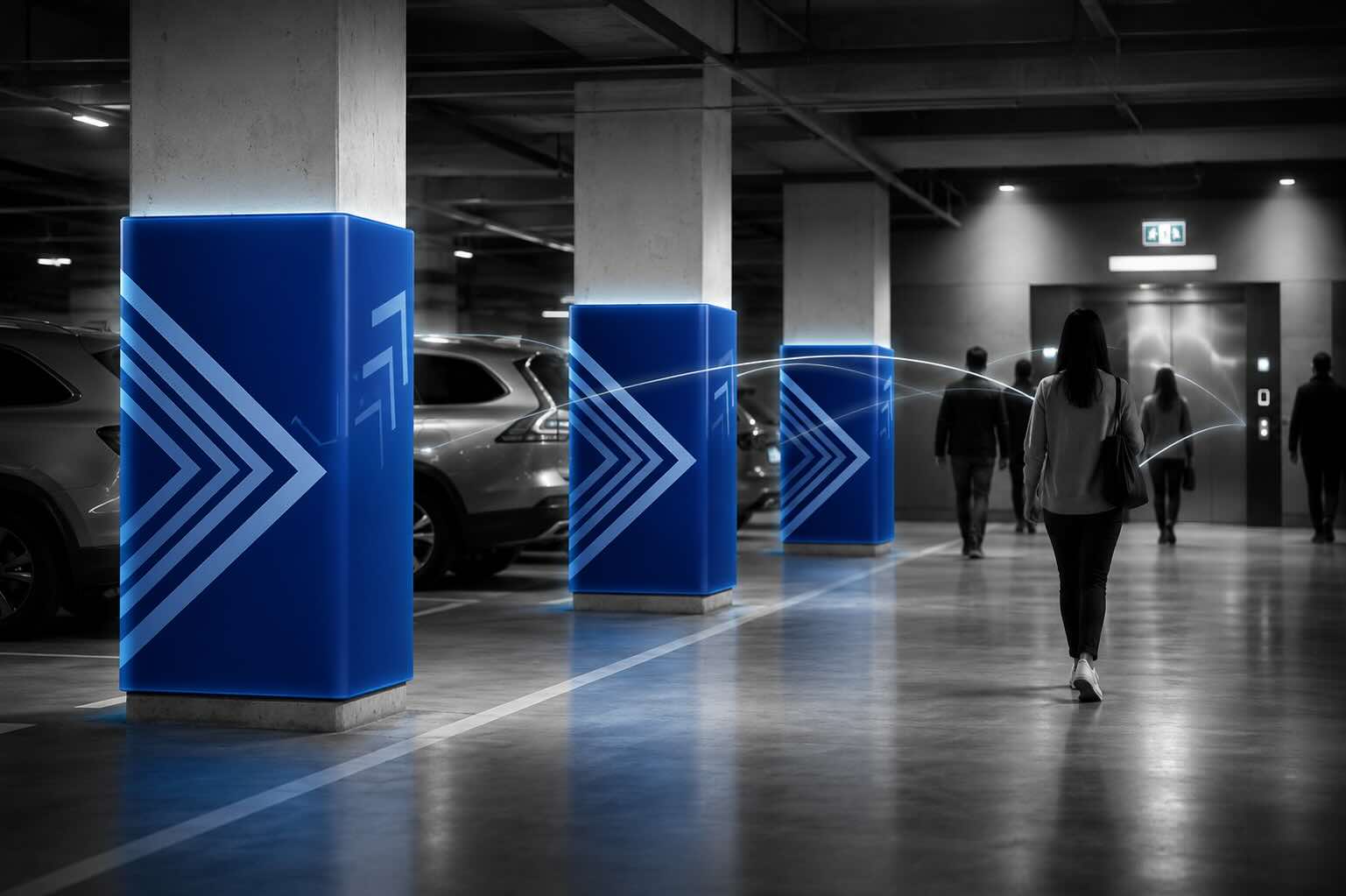
Digital ads get skipped. Billboards get ignored. But closed-loop environments deliver something different.
Here’s a stat that should get your attention:
Out-of-home advertising delivers 84-86% consumer ad recall.
That’s according to Solomon Partners’ 2025 analysis of advertising effectiveness across major media channels. To put it in perspective: online ads achieve 46-57% recall. Streaming TV hovers in a similar range. OOH nearly doubles both.
In a world of ad blockers, subscription services, and infinite scroll, physical advertising is experiencing a renaissance. And parking structures represent some of the most undervalued OOH inventory available.
Why OOH Is Outperforming Digital
The resurgence of out-of-home advertising isn’t accidental. Several structural factors are driving the shift:
- Ad blocking: Roughly 40% of internet users employ ad blockers. You can’t block a billboard.
- Subscription fatigue: Consumers increasingly pay to avoid ads on streaming platforms. Physical environments don’t offer that option.
- Cookie deprecation: As digital tracking becomes more restricted, the deterministic audiences available through physical locations become more valuable.
- Attention scarcity: Digital ads compete with infinite content. Physical ads exist in environments where attention is already allocated to navigation and awareness.
A five-year study by Kantar found that OOH delivers a 13.3% increase in ad awareness compared to digital media, TV, and connected TV. The research showed OOH consistently outperforms digital channels across brand favorability and purchase intent as well.
MAGNA projects OOH as the fastest-growing legacy medium in 2025, with digital out-of-home (DOOH) leading the charge at approximately 12% growth.
The Closed-Loop Advantage
Not all OOH is created equal. A highway billboard gets a fraction of a second of attention from drivers focused on the road. A transit ad competes with phones and fellow passengers for attention.
Parking structures offer something different: a closed-loop environment with guaranteed, repeated exposure.
Consider the visitor journey. A driver enters the garage, navigating slowly while looking for a spot. They pass columns multiple times while parking. They walk past columns to reach the elevator. Hours later, they reverse the journey walking back, finding their car, driving out.
A European eye-tracking study measured this precisely. Using VR headsets with eye-tracking technology, researchers found that 100% of participants noticed advertisements on column wraps. Each driver viewed the ads an average of 17 times during a single visit.
That’s not comparable to a billboard glimpsed at 65 mph. It’s sustained, repeated exposure in an environment where visitors are already in navigation mode, actively scanning their surroundings.
The CPM Advantage
Beyond effectiveness, OOH offers cost efficiency that surprises many advertisers.
Solomon Partners’ analysis found that OOH delivers the lowest CPMs (cost per thousand impressions) across major media channels. When you combine best-in-class recall rates with lowest-in-class costs, the ROI equation becomes compelling.
For property owners, this means advertisers are willing to pay meaningful rates for parking structure placements — especially when you can demonstrate the captive audience, repeat exposure, and high-intent visitor demographics.
What Advertisers Want
Brands evaluating OOH placements look for several characteristics:
- Guaranteed visibility: No ad blockers, no skip buttons, no algorithm deciding whether to show the ad
- Audience quality: High-income, high-intent visitors — people actively engaged in shopping, travel, healthcare, or hospitality
- Frequency: Multiple exposures per visit, building recall and brand familiarity
- Context: Relevant environments where the brand message aligns with visitor mindset
Parking structures at premium properties check every box. A luxury mall garage delivers affluent shoppers. A hospital garage reaches healthcare decision-makers. An airport garage captures business travelers. A hotel garage provides visitors in spending mode.
The Untapped Inventory
Here’s the opportunity: most parking structures haven’t recognized what they’re sitting on.
While retail media networks are valued in the hundreds of billions, physical retail media (including parking) captures less than 1% of that spend. The inventory exists; it simply hasn’t been activated.
Property owners who move first can capture advertiser relationships and establish rate cards before the market matures. The same columns that currently display nothing, or faded wayfinding from a decade ago, represent premium inventory that brands will pay to access.
The Bottom Line
Digital advertising is getting harder. Ad blockers, privacy restrictions, and subscription services are eroding reach and effectiveness. Meanwhile, physical advertising in controlled environments is delivering recall rates that digital can’t match.
Your parking structure is OOH inventory you already own. Every column is a potential placement. Every visitor represents impressions you’re currently giving away.
The question isn’t whether this opportunity exists the data is clear. The question is whether you’ll capture it before your competitors do.
Cingo [Column Wraps] transforms parking columns into high-impact advertising platforms with 84%+ recall rates in captive, closed-loop environments. Turn overlooked infrastructure into revenue-generating assets. Learn more at cingos.com.
Frequently Asked Questions About Out-of-Home Ad Recall in Parking Garages
01How does out-of-home advertising compare with digital for ad recall?
+
The article cites Solomon Partners’ 2025 analysis of advertising effectiveness, which reported 84 to 86 percent consumer ad recall for out-of-home advertising, against 46 to 57 percent for online ads, with streaming TV in a similar range to online. That is nearly double. The figures are for out-of-home as a whole, not parking garages specifically, so treat them as context for the channel rather than a promise for a single garage.
02Why is out-of-home outperforming digital advertising?
+
The article points to structural factors. Ad blocking is one: roughly 40 percent of internet users use ad blockers, and you cannot block a physical advertisement. Subscription services and infinite scroll also make digital ads easier to skip, while physical advertising exists in the real environment people occupy. The article describes this as a renaissance for out-of-home, with digital out-of-home growing at roughly 12 percent.
03What is a closed-loop environment, and why do parking garages qualify?
+
The article says a highway billboard gets a fraction of a second of attention from drivers focused on the road, and a transit ad competes with phones and fellow passengers. A parking structure is different: a closed-loop environment with guaranteed, repeated exposure. A driver enters slowly, passes columns several times while parking, walks past them to the elevator, then reverses the journey hours later. That sustained, repeated exposure is what the article contrasts with a billboard glimpsed at 65 mph.
04What did the European eye-tracking study find about column wraps?
+
The article says researchers used VR headsets with eye tracking and found that 100 percent of participants noticed advertisements on column wraps, with each driver viewing the ads an average of 17 times during a single visit. The article does not name the study or give its sample size, so verify it before quoting it to advertisers. It is the article’s evidence that garage column placements are seen repeatedly, not once.
05Which kinds of parking garages are best for advertisers?
+
The article’s test is audience quality, frequency and context. It says a luxury mall garage delivers affluent shoppers, a hospital garage reaches healthcare decision-makers, an airport garage captures business travelers, and a hotel garage provides visitors in spending mode. It adds that physical retail media, including parking, captures less than 1 percent of retail media spend, so most structures have not yet activated the inventory they hold, and early movers can build advertiser relationships first.